Search

Social media analysis

Graph Intelligence and Security

Use this showcase if you’re building an application where analysts need to connect online identities, accounts and posts across social media platforms. It demonstrates how entity resolution can turn scattered identifiers into a clearer network, so relationships are easier to interpret at the level of people and groups rather than individual accounts alone.

What the showcase demonstrates

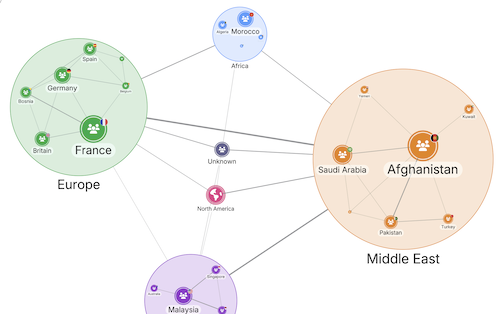
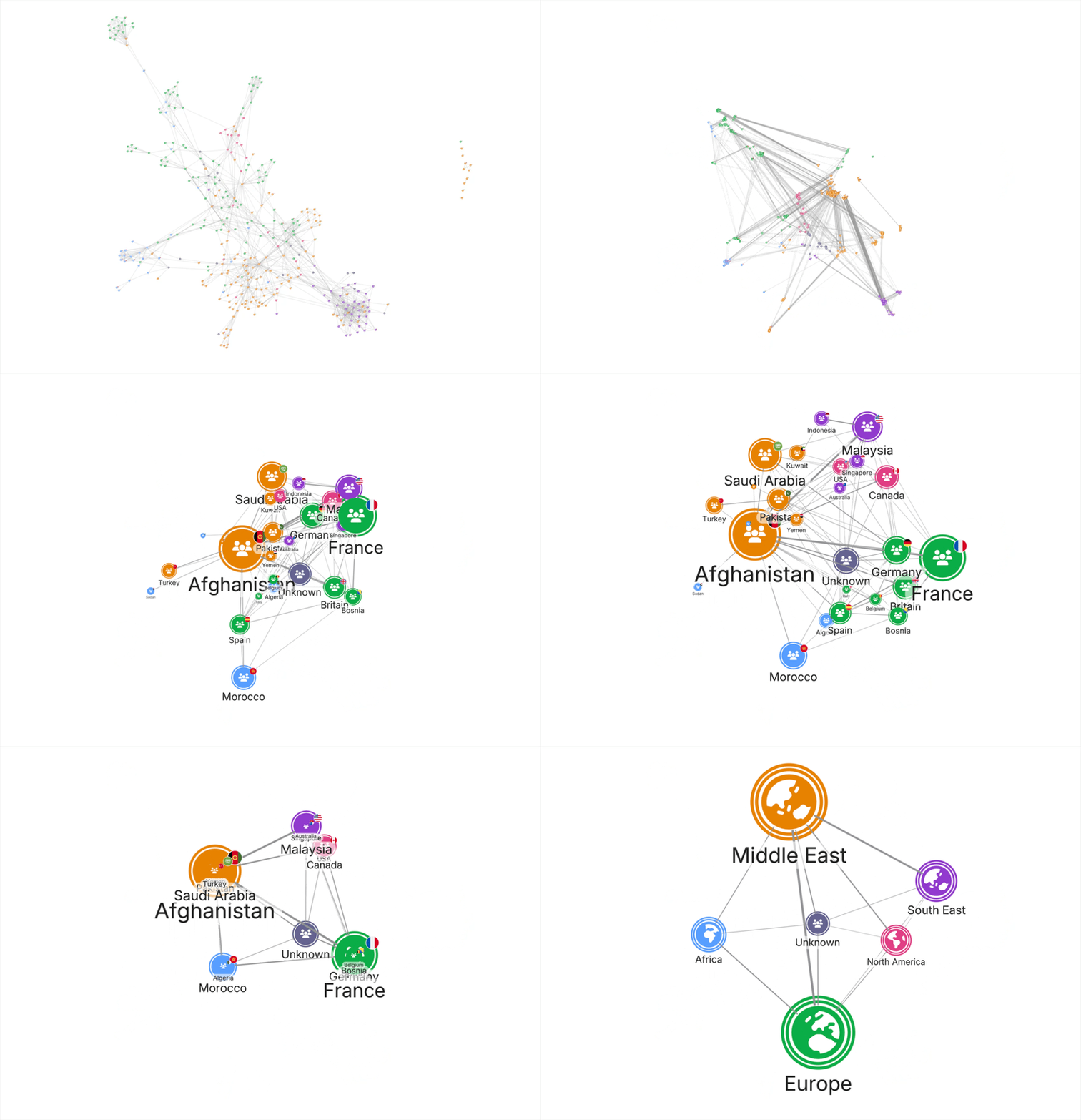

The showcase follows a fictional group of people linked by their activity across several social media accounts. Instead of filling the top-level view with every account, post and interaction, the network combines related identifiers around the person they belong to. This gives analysts a cleaner starting point for understanding how individuals are connected.

The detail is there when it matters. A user can expand a combined entity to inspect that person’s social media activity, then select an individual post to reveal links to others in the network. This allows a user to easily switch from a high-level relationship view to specific communications that explain each connection.

The workflow is useful when digital activity is fragmented across platforms. Analysts can identify which accounts belong to the same person, trace how information moves through a group and decide where to investigate next.

What you can evaluate

For product and engineering teams, this showcase demonstrates how the SDKs can support entity resolution, grouped network exploration through our combos feature, and detail-on-demand interactions. It shows how complex communication data can be simplified visually while preserving access to the underlying accounts, posts and relationships.

Although this example uses social media data, the same approach can support other relationship-heavy workflows, from suspect networks and group dynamics to influence mapping, customer intelligence and account analysis.
More from Cambridge Intelligence

See all →

Terms of use

These terms do not alter or supersede any existing agreements between you (or your employer) and us.

By accessing or using any Content you agree to be bound by these Terms of Use. Please review these terms carefully before using the website.

The contents of this website, including but not limited to any text, code samples, API references, schemas, interactive tools, and other materials (collectively, the 'Content'), are made available for informational and internal evaluation purposes only. All intellectual property rights in the Content are reserved. No licence is granted to use the Content for any commercial purpose, or to copy, distribute, modify, reverse-engineer, or incorporate any part of the Content into any product or service, without our prior written consent.

This Content is provided “as is” and “as available,” without any representations, warranties, or guarantees of any kind, whether express or implied, including but not limited to implied warranties of merchantability, fitness for a particular purpose, non-infringement, or accuracy. To the fullest extent permitted by applicable law, we expressly exclude and disclaim all implied warranties, conditions, and other terms that might otherwise be implied.

We disclaim all liability for any loss or damage, whether direct, indirect, incidental, consequential, or otherwise, arising from any reliance placed on the Content or from your use of it, to the fullest extent permitted by applicable law. By continuing to access or use the Content, you acknowledge and agree to these terms.